Skip to content




What you’ll learn:
- Why websites ranking the “Best Gold IRA Company” may earn substantial commissions from the dealers they recommend.
- How misleading fee comparisons can conceal $20,000–$30,000 or more in precious-metals markups.
- Why a highly rated, heavily promoted Gold IRA company is not necessarily a financially sound or competitively priced company.
- How to identify expensive exclusive coins, questionable bonus promotions, and products that are difficult to resell.
- Seven practical tests that reveal whether a Gold IRA company deserves your business.
What Is the Best Gold IRA Company?
The best Gold IRA company is one that combines a verifiable track record, transparent precious-metals pricing, recognized IRA-eligible bullion, reliable service, and competitive resale options. Rather than relying on paid rankings, investors should compare identical products, calculate their cost per fine ounce, examine complaints and regulatory history, and verify how much independent dealers would pay for those metals.
That is how to evaluate a Gold IRA company based on what matters to your retirement savings. A first-place ranking, celebrity endorsement, five-star graphic, or impressive website cannot substitute for those facts.
Certified Gold Exchange examined 28 current and historical Gold IRA ranking pages and related marketing materials. Our review found an important problem with the industry’s online recommendation system: Many ranking pages evaluate the companies’ marketing claims without independently establishing the prices investors will actually pay.
The Truth About “Best Gold IRA Company” Rankings
Search Google for “best gold IRA company” and you’ll find websites presenting carefully organized lists of recommended dealers. Their pages often feature professional-looking scoring systems, editorial awards, comparison tables, glowing reviews, and reassuring descriptions of customer service.
What many readers don’t realize is that the publishers may earn money when someone clicks a link, calls a tracked telephone number, requests a guide, submits contact information, opens an account, or completes a precious-metals purchase. Some programs offer commissions calculated as a percentage of qualifying transaction value.
The commercial arrangement does not automatically make every recommendation dishonest. However, it creates a substantial conflict of interest when the publisher’s income depends on steering readers toward particular dealers.
A paid ranking is not proof that the first-place company offers the best prices, most gold, or strongest consumer protection.
The ranking may be the advertisement
Imagine a website that recommends five Gold IRA companies and earns money from four of them. Unless the publisher explains its selection criteria and compensation arrangements, readers cannot determine whether the fifth company received a fair evaluation—or whether dozens of nonpaying companies were excluded entirely.
A financially motivated ranking can look remarkably similar to independent financial journalism. The difference becomes apparent when the reader asks for actual transaction evidence.
Did the publisher request written gold prices from each dealer? Did it compare identical coins, calculate fine gold ounces, or obtain independent resale quotations?
If not, the website has not demonstrated which company offers the best financial value.
What the FTC Says About Paid Rankings
The Federal Trade Commission’s endorsement guidance specifically addresses websites that accept money in exchange for higher positions on ranked lists. Its example explains that manipulating rankings through payment can be deceptive even when a publisher does not expressly claim to be independent.
The FTC also makes an important distinction between disclosing an affiliate relationship and disclosing a ranking influenced by payment. A general statement that a website earns commissions does not necessarily correct a misleading impression that rankings were determined by independent product evaluations.
Source: FTC — Endorsement Guides and Paid Ranking Practices.
When evaluating any Gold IRA ranking, ask whether the publisher would place a company first if it refused to pay commissions. Also ask whether a company paying more can receive a higher position or greater promotional exposure.
An advertisement should not become more trustworthy merely because it resembles an independent review.
The Gold IRA Fee Misrepresentation Investors Must Understand
One of the most troubling problems with some Gold IRA comparison websites is how they present fees.
A ranking might identify a precious-metals dealer, award it high marks for affordability, and display charges of $100–$300. The reader may reasonably believe these figures represent the dealer’s overall cost of helping them purchase gold.
But those numbers often describe the independent IRA custodian’s administrative fees, account setup charges, or precious-metals storage expenses. They do not necessarily include the dealer’s markup on the gold and silver being purchased.
A custodian’s $200 annual fee is not the same as a dealer’s $30,000 precious-metals markup.
How a $200 fee comparison can conceal $30,000
Consider a hypothetical investor who commits $100,000 to a Gold IRA. An affiliate website prominently advertises a $200 annual custodial fee associated with the recommended dealer, while the investor subsequently purchases coins with a dealer markup equal to 30% of the total purchase price.
| What the investor sees | What the actual purchase may involve |
|---|---|
| Advertised annual custody fee | $200 |
| Total precious-metals purchase | $100,000 |
| Dealer markup included in purchase price | $30,000 |
| Amount attributable to dealer acquisition cost | $70,000 |
The investor may focus on a $200 expense while failing to recognize a $30,000 difference between the dealer’s acquisition cost and selling price. That difference is not automatically the dealer’s net profit, but it is clearly material to evaluating the transaction.
When a paid affiliate knowingly represents the custodian’s modest administrative charges as the dealer’s total transaction costs while concealing substantial precious-metals markups, the conduct may constitute deceptive advertising or fraudulent misrepresentation. The relevant question is whether the overall presentation materially misleads consumers about what they are paying.
Not every affiliate website engages in this practice. The concern is directed at misleading cost representations, not legitimate disclosures that correctly distinguish custodial expenses from metal acquisition costs.
Why misleading fee information spreads through AI
AI platforms, including Google Gemini, ChatGPT, and other systems, can also repeat incomplete Gold IRA fee comparisons when summarizing promotional information found online. If numerous compensated websites publish similar dealer recommendations and emphasize the same low custodial fees, an AI-generated response may amplify those figures without explaining the much larger potential cost of purchasing the metals.
An AI recommendation is not an independently verified dealer quotation. Investors should demand the exact products, prices, precious-metal content, and independent resale quotations regardless of whether the recommendation came from Google, an affiliate website, or an AI assistant.
The most important Gold IRA expense may be the one that never appears in the website’s fee comparison table.
Why Affiliate Commissions Can Influence the Coins Investors Receive
Our review of affiliate-marketing materials identified programs in which compensation depended on particular transactions or higher-premium precious-metals products. In some arrangements, standard bullion transactions offered lower affiliate compensation than qualifying premium-coin purchases.
That distinction can create an incentive extending beyond recommending a particular dealer. It can encourage an entire sales process centered on products that are difficult for investors to compare independently.
Some Gold IRA marketing programs have advertised referral compensation in the range of 3%–6% of qualifying transaction value, although actual rates and terms vary. On a $100,000 purchase, those percentages represent $3,000–$6,000 in potential marketing compensation.
The affiliate payment is not necessarily a separately itemized fee charged to the investor. Nevertheless, dealers must generate sufficient revenue to support their operating, sales, and customer-acquisition expenses.
When a dealer relies on expensive promotional arrangements and higher-premium products, investors should examine whether they are receiving competitive metal value for their money.
Recognized Bullion Versus Exclusive Gold IRA Coins
Widely recognized bullion includes American Gold Eagles, Canadian Gold Maple Leafs, and qualifying bullion bars from established manufacturers. These products have documented precious-metal specifications and active dealer markets, making price comparisons relatively straightforward.
Exclusive or proprietary coins can be authentic, attractive, and manufactured by respected mints. However, their selling prices may include additional premiums that independent buyers do not necessarily recognize when the investor wants to sell.
The prestigious mint strategy
Some dealers promote unfamiliar limited-production coins manufactured by prestigious sovereign mints. Investors recognize the mint’s reputation and assume that a coin bearing its name must be a sound investment at the dealer’s asking price.
That assumption can be expensive because the reputation of the mint establishes confidence in the coin’s authenticity and specifications—not the fairness of the dealer’s retail price.
A world-famous mint can produce a coin you’ve never heard of. Never confuse trust in the mint with trust in the markup.
For a complete explanation of the differences, see Best Gold IRA Products: Eagles and Maples Versus Exclusive Coins.
The $100,000 Test: How Much Gold Are You Actually Buying?
Suppose two investors each spend $100,000 when the hypothetical gold spot price is $4,000 per ounce.
One purchases recognized bullion at 8% above spot. The other purchases unfamiliar premium coins at 40% above spot.
| Comparison | Recognized bullion | Premium coins |
|---|---|---|
| Investment | $100,000 | $100,000 |
| Premium above spot | 8% | 40% |
| Price per fine ounce | $4,320 | $5,600 |
| Gold received | 23.15 oz | 17.86 oz |
| Difference | 5.29 more ounces | — |
The bullion investor receives approximately 29.6% more gold for the same investment. The additional 5.29 ounces represent approximately $21,160 in underlying gold value at the illustrated spot price.
The higher-premium coins might possess legitimate collectible value, but that value should be established through independent market bids. A dealer’s sales presentation is not proof that a future buyer will repay the original premium.
Before signing anything, calculate your effective price per fine ounce and compare it with competing quotations for identical or economically comparable products.
You can learn more about the calculation in Did I Overpay for Gold Coins? and review broader investment considerations in CGE’s Gold Investment Guide.
Beware of “Free Silver,” Bonus Gold, and Waived Fees
Promotions offering complimentary precious metals, account credits, free storage, or waived administrative fees can appear attractive. However, the economic value of the offer depends on the entire transaction, including the prices charged for every product purchased.
Imagine receiving $5,000 in bonus silver while the main gold purchase costs $15,000 more than an independently comparable offer. The promotion may sound generous, but the complete transaction leaves the investor in a worse position.
Not every promotional offer is misleading. The correct test is whether the total package delivers competitive metal value after all charges, credits, and bonuses are considered.
Instead of asking how much free metal you’ll receive, ask how many total fine ounces of gold and silver you will own for the same amount of money.
Seven Tests for Finding the Best Gold IRA Company
You don’t need to become a precious-metals expert to make a better-informed decision. You need a consistent process that separates verifiable facts from marketing claims.
1. Investigate the company’s entire history
Examine years in business, leadership, complaint records, regulatory actions, litigation, and bankruptcy history. A strong Google rating or A+ BBB grade can provide useful context, but neither independently verifies fair pricing or the safety of customer funds.
Read actual complaint narratives rather than relying solely on an average star rating. Pay particular attention to allegations of undelivered metals, delayed liquidation proceeds, unauthorized substitutions, excessive premiums, and unfulfilled buyback representations.
2. Demand a complete written product quotation
The dealer should identify each coin or bar, its manufacturer, weight, purity, quantity, unit price, and total cost. Avoid authorizing broad categories such as “premium gold coins” without understanding exactly what will be delivered.
Compare offers obtained close together in time because precious-metal prices change throughout the trading day. Keep the original written quotations for your records.
3. Calculate your cost per fine ounce
Divide the amount allocated to each metal by the number of fine troy ounces you’re purchasing. This provides a direct way to compare offers with different quantities or premiums.
A lower advertised annual fee means little if another dealer would provide substantially more gold for the same purchase amount. Compare gold with gold and silver with silver, using equivalent products and transaction terms.
4. Verify the resale price before buying
Ask the dealer what it would pay to repurchase the exact products under current market conditions. Then obtain independent bids so you can evaluate the difference between purchase and potential resale prices.
The CFTC’s physical precious-metals advisory specifically recommends examining spreads, fees, commissions, and buyback prices. It also warns that high transaction costs may make recovering the original investment extremely difficult.
5. Separate custodians from dealers
A Gold IRA custodian administers the retirement account, while a precious-metals dealer sells the physical products. Depositories provide storage under applicable arrangements, and each participant may have its own charges and responsibilities.
Custodian involvement should never be mistaken for independent verification of the dealer’s selling price. Learn how these relationships work in CGE’s Gold IRA Custodians Guide.
6. Investigate the ranking website itself
Determine who pays the publisher, whether payments influence rankings, and whether companies that refuse to pay commissions were considered. Ask whether the reviewer obtained written purchase quotes and independently verified buyback prices.
A ranking that cannot explain its compensation arrangements or demonstrate meaningful price comparisons should not be treated as conclusive financial research. Favor transparent evidence over badges, awards, and unexplained scoring systems.
7. Test the salesperson’s response to your instructions
Tell the dealer you want a written quotation for 100% recognized, IRA-eligible bullion, such as standard one-ounce American Gold Eagles or Canadian Gold Maple Leafs. If the salesperson insists on redirecting you into unfamiliar, exclusive, or specially labeled coins, ask why and demand an independently verifiable comparison.
A reputable dealer should explain legitimate availability and eligibility limitations while respecting the products you have chosen. Unwanted substitutions or pressure to purchase difficult-to-compare coins are good reasons to stop the transaction.
The best Gold IRA company should welcome independent pricing comparisons, not discourage them.
What Past “Best Gold IRA Company” Recommendations Teach Us
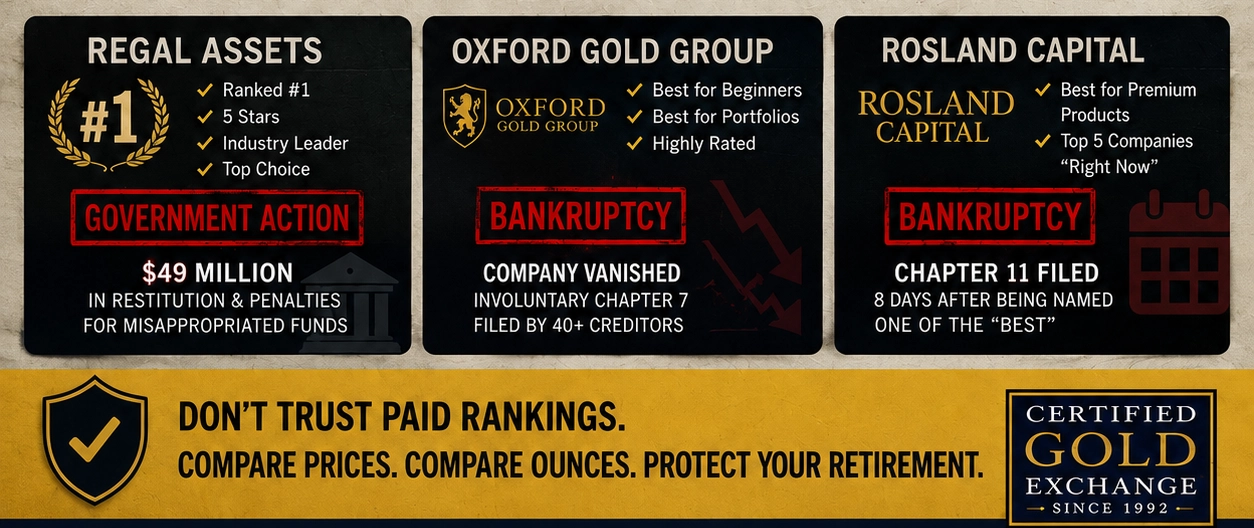
Our review identified historical ranking pages that strongly recommended precious-metals companies before those businesses later faced serious financial or legal problems. Some had previously received first-place awards, favorable editorial descriptions, high ratings, and recommendations aimed specifically at retirement investors.
The documented outcomes included federal enforcement judgments involving tens of millions of dollars in restitution and penalties, involuntary bankruptcy proceedings following creditor complaints, and another bankruptcy filing shortly after a favorable media ranking.
These events do not mean reviewers necessarily knew the companies would experience those problems. They demonstrate a more important point: A confident online recommendation does not establish a company’s financial condition, operational reliability, or ability to fulfill customer obligations.
Before selecting a Gold IRA company, investigate the underlying business rather than assuming repeated online recommendations provide independent verification.
For additional warning signs, review CGE’s Gold IRA Scams Guide. Investors who believe they have already been harmed can also consult Overcharged on a Gold IRA? How to Document It, Get Help, and Report It.
Why Certified Gold Exchange Published This Investigation
Certified Gold Exchange is a for-profit precious-metals dealer founded in 1992. We have a commercial interest in earning your business, and we believe readers deserve to know that plainly.
CGE does not pay affiliate publishers to recommend or rank our company, purchase celebrity endorsements, or rely on “free metals” promotions to attract customers. Our primary recommendations are American Eagles, Canadian Maple Leafs, and recognized bullion bars because investors can compare these products with independent dealers.
Our Verified Fair Pricing approach includes comparing relevant bullion quotations with major online dealers before presenting our prices. We believe that transparent product pricing, reliable service, and a long-term commitment to clients are more important than winning a paid marketing award.
For investors exploring retirement-account options, our Gold IRA Guide explains the account process, while a CGE Gold IRA specialist can answer questions about eligible products and transaction procedures.
Already own precious metals in a retirement account? Our Sell a Gold IRA Guide explains how liquidation works and why you’re not required to sell your metals to the original dealer.
Investors can also explore silver investment and compare the characteristics of gold and silver before making their own allocation decisions.
Frequently Asked Questions
Which is the best Gold IRA company?
The best choice depends on independently verified pricing, product availability, service quality, custodian arrangements, and the company’s business history. Rather than trusting a first-place ranking, request comparable written bullion quotations and investigate the full purchase-to-resale costs before choosing a dealer.
Are “Best Gold IRA Company” rankings paid advertisements?
Many Gold IRA ranking pages receive affiliate compensation, but not every compensated review is necessarily deceptive. The critical questions are whether the financial relationship is clearly disclosed, whether it influences rankings, and whether the publisher has performed meaningful independent evaluations.
Why do Gold IRA rankings advertise fees of only $100–$300?
Those amounts often describe custodial administration, setup, or storage charges rather than the precious-metals dealer’s markup. Investors should separately calculate the total cost of buying the metals, including premiums above spot and other applicable transaction expenses.
How much should a Gold IRA company charge above spot?
There is no universal premium suitable for every precious-metals product. For standard bullion, compare written quotations from independent dealers for identical products and obtain resale bids to understand how the purchase premium affects the initial investment.
Are Gold Eagles and Canadian Maple Leafs better than exclusive coins?
For investors prioritizing transparent pricing and established resale markets, widely recognized bullion is generally easier to evaluate. Exclusive coins can have legitimate collectible value, but buyers should verify that value independently before paying large additional premiums.
Can I trust a company with five-star reviews and an A+ BBB rating?
Positive reviews and business ratings are useful research inputs, not guarantees of competitive prices or future performance. Examine actual complaints, unresolved disputes, regulatory proceedings, and the company’s ability to deliver and repurchase metals.
What is the difference between a Gold IRA dealer and custodian?
The dealer sells precious metals, while the custodian administers the retirement account under applicable rules. Investors should evaluate the custodian’s administration and storage costs separately from the dealer’s bullion purchase prices.
What should I do if I already purchased overpriced Gold IRA coins?
Gather your invoice, identify the exact products and fine metal content, and obtain independent buyback quotations before authorizing another transaction. Do not automatically exchange or liquidate the metals without understanding potential additional spreads, account procedures, and applicable tax consequences.
The Bottom Line: The Best Gold IRA Company Must Prove Its Value
A Gold IRA company should not earn your trust simply because an affiliate website awarded it first place. It should earn that trust by providing verifiable products, competitive written prices, an established business history, and straightforward answers about the costs of purchasing and selling precious metals.
Before transferring retirement savings, determine who profits from the recommendation, what products you will receive, how much fine gold or silver you’re purchasing, and what independent dealers will pay for those products. Those facts reveal far more than a celebrity endorsement, a promotional bonus, or a ranking badge.
The best Gold IRA company isn’t the one that pays to be called the best. It’s the company willing to prove the value of what it sells.
For information about competitively priced American Eagles, Canadian Maple Leafs, or recognized bullion bars, call Certified Gold Exchange at 800-300-0715.
Commercial Disclosure and Important Information
Certified Gold Exchange is a precious-metals dealer with a commercial interest in earning customers. This article examines Gold IRA ranking practices and does not assert that every affiliate relationship is unlawful or that every dealer appearing on a compensated ranking has engaged in misconduct.
This material is provided for consumer education, not personalized financial, investment, tax, or legal advice. CGE specialists are precious-metals professionals, not licensed investment advisers, and all transactions are client-directed. Precious-metals prices can decline, and investors should consult appropriate independent professionals regarding their circumstances.
For documented corrections or substantive responses and to insure your not a victim of gold IRA affiliates contact Certified Gold Exchange.
Transparent & Competitive Pricing
Exceptional Service.
-
 BBB Rating
Zero Complaints
BBB Rating
Zero Complaints
- 5.0 Star Google Review Rating
-
 58,000+ Served
In All 50 States
58,000+ Served
In All 50 States
-
 Serving Investors
Since 1992


CERTIFIED GOLD EXCHANGE
AMERICA'S TRUSTED SOURCE FOR GOLD
2026 GOLD IRA SMART MOVES GUIDE

VERIFIED FAIR
PRICING

EXPERT
INSIGHTS

AVOID COSTLY
MISTAKES