Skip to content


Table of Contents
Is My Retirement Account Gold IRA Eligible?
Written by Pat Collins and John Halloran | 5.0 Google Review Rating | A+ BBB Rating with Zero Complaints | Serving 58,000+ Investors in All 50 States Since 1992. Updated 8/13/26.
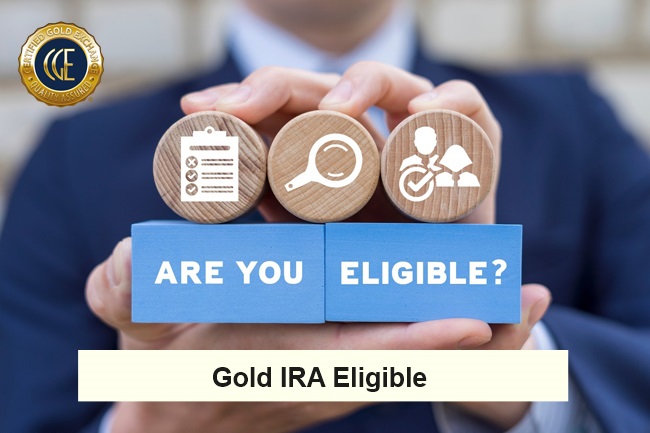
Most retirement accounts can be transferred or rolled over to a gold IRA. Traditional, Roth, SEP, and SIMPLE IRAs transfer directly, as do 401(k), 403(b), 457(b), and TSP accounts from former employers. Plans with your current employer usually aren’t eligible until age 59½, when many allow an in-service distribution.
What retirement accounts are gold IRA eligible?
A gold IRA is a self-directed IRA that holds physical precious metals instead of paper assets. The account type doesn’t change — a Traditional IRA moved into a gold IRA is still a Traditional IRA, with the same contribution limits, distribution rules, and tax treatment. What changes is what’s inside it.
Traditional IRA
Eligible. Funds move from a Traditional IRA into a self-directed Traditional gold IRA with no tax or penalty, provided you use a direct trustee-to-trustee transfer. Tax treatment is unchanged.
Roth IRA
Eligible. A Roth IRA transfers into a self-directed Roth gold IRA the same way. Your five-year clock and qualified-distribution rules carry over — moving to a self-directed account doesn’t restart them.
SEP IRA and SIMPLE IRA
Eligible. Simplified Employee Pension and SIMPLE IRAs both transfer into self-directed equivalents — a common route for self-employed investors and small business owners adding metals.
One timing rule on SIMPLE IRAs. During your first two years in the plan, a SIMPLE IRA can only move to another SIMPLE IRA. Move it anywhere else inside that window and the IRS treats it as a distribution — with a 25% additional tax if you’re under 59½, not the usual 10%. After two years it transfers like any other IRA. (IRS: SIMPLE IRA withdrawal and transfer rules)
401(k), 403(b), 457(b), and TSP from a former employer
Eligible. Once you’ve left the employer, these can be rolled into a self-directed IRA. A direct rollover — plan to custodian, without the money passing through your hands — avoids the mandatory 20% withholding that applies to indirect rollovers from employer plans.
Inherited IRAs
Eligible. If you’ve already inherited an IRA — as a spouse or as a child of the original owner — you can move it into a self-directed inherited IRA and hold physical metals in it. The account stays titled as an inherited IRA. What changes is what’s inside it.
- Move it trustee-to-trustee. The funds go directly from one custodian to the other and never pass through your hands. For non-spouse beneficiaries this is the only permitted method — a distribution taken personally can’t be put back.
- If you inherited from a parent, know your drawdown window. Most non-spouse beneficiaries must empty the account within 10 years of the original owner’s death, and some owe annual RMDs along the way. That’s a defined holding period, so it pays to hold liquid, widely traded bullion you can sell in portions on your own schedule — not “exclusive” coins with a thin resale market.
- If you’re the surviving spouse, check how the account is titled. Spouses can elect to treat an inherited IRA as their own, which removes the 10-year clock and puts it back under standard IRA rules. If that election wasn’t made when you inherited, it may still be available — worth confirming before you move anything.
The specifics depend on your relationship to the original owner and the date of death, so confirm your situation with your tax advisor first — then call us at 800-300-0715 and we’ll coordinate the metals side with your custodian. IRS Publication 590-B has the governing rules.
Which retirement accounts are not gold IRA eligible?
Plans with your current employer
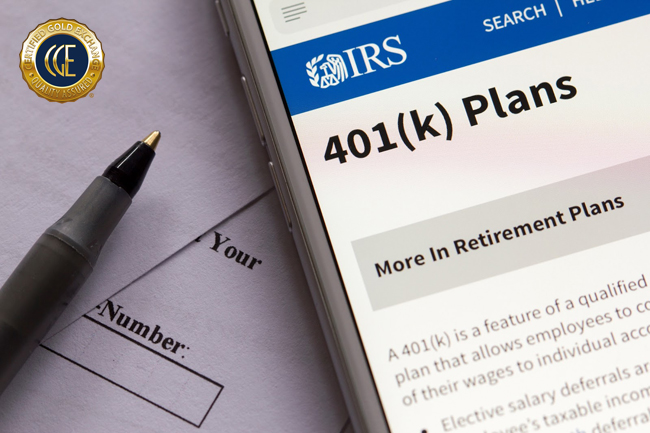
Usually not eligible while you’re still employed. 401(k), 403(b), 457(b), and TSP accounts with your current employer generally can’t be moved into a self-directed IRA. There is a common exception — see the next section.
Non-qualified accounts
Not eligible. Brokerage accounts, savings, and other personal investments outside the retirement system can’t be converted into an IRA. You can buy metals with those funds for direct delivery, but that’s a purchase, not a rollover.
State and local government pension plans
Generally not eligible. Defined-benefit pensions have their own withdrawal and rollover rules, and most don’t permit transfers to a self-directed IRA while you’re an active participant.
Can I move a current employer’s 401(k) into a gold IRA?
Sometimes — through an in-service distribution. Many plans allow participants aged 59½ or older to move a portion of their balance out while still employed. This lets you roll part of the account into a self-directed IRA and leave the rest where it is, still contributing and still receiving any employer match.
In-service distributions are permitted at the plan’s discretion, not guaranteed by law, so the answer is specific to your retirement plan. Ask your plan administrator whether you’re eligible for an in-service distribution, or call our IRA desk at 800-300-0715 and we’ll help you work through it.
What metals are gold IRA eligible?
The IRS sets a minimum fineness for each metal held in an IRA. Bullion must come from a government mint or an accredited refiner, assayer, or manufacturer.
| Metal | Minimum fineness | Commonly held eligible products |
|---|---|---|
| Gold | 99.5% (.995) | American Gold Buffalo, Canadian Gold Maple Leaf, Austrian Philharmonic, accredited-refiner bars |
| Silver | 99.9% (.999) | American Silver Eagle, Canadian Silver Maple Leaf, accredited-refiner bars |
| Platinum | 99.95% (.9995) | American Platinum Eagle, Canadian Platinum Maple Leaf |
| Palladium | 99.95% (.9995) | Canadian Palladium Maple Leaf, accredited-refiner bars |

One important exception: the American Gold Eagle. Gold Eagles are 22-karat, about 91.67% fine, so they don’t meet the 99.5% bar — but they’re permitted in IRAs anyway because federal law names them specifically. They remain one of the most commonly held IRA coins.
Compare that to the South African Krugerrand, which is the same 91.67% purity — and is not IRA eligible, because it isn’t named in the statute. Same fineness, opposite answer. That’s the clearest illustration of the underlying rule: fineness minimums and the statutory coin exceptions are two separate tests, and a coin has to pass one of them.
Which coins are not IRA eligible?
Collectible and numismatic coins are excluded by statute — including several popular bullion coins that people assume qualify:
- South African Krugerrand — 91.67%, not statutorily named
- United Kingdom Sovereign
- French 20 Franc
- US Liberty and other pre-1933 US gold
- Graded, certified, or “proof” coins sold at numismatic premiums
And be careful with “exclusive” or “premium” coins. Some dealers market these as IRA-appropriate at markups of 30% or more over melt value. They’re typically ordinary bullion with a proprietary label attached — the premium buys you nothing you can recover on resale. We deal only in widely traded bullion with transparent, verifiable pricing. See our guide to gold IRA mistakes and scams for the full list of tactics.
All IRA metals must be held at an IRS-approved depository. Storing IRA metals at home or in a personal safety deposit box is treated as a distribution of those assets — which can mean income tax on the full amount plus, if you’re under 59½, a 10% additional tax. The Tax Court addressed this directly in McNulty v. Commissioner (2021). Any dealer offering a “home storage gold IRA” is describing something the IRS does not recognize.
How do you move funds without triggering taxes?
Ask for a direct transfer. Money moves custodian-to-custodian and never touches your account — no withholding, no reporting event, no annual limit. This is how nearly every gold IRA gets funded, and it’s the term to use with your custodian by name.
Watch for a check in the mail. If you’re moving an old 401(k), 403(b), or TSP and the plan administrator sends the money to you instead of transferring it directly, they’re required to withhold 20% for taxes. You then have 60 days to deposit the full original amount — including the 20% you never received — or the shortfall counts as a distribution, plus a 10% additional tax if you’re under 59½. Asking for a direct rollover up front avoids the whole situation (IRS Topic 413).
RMDs still apply. A gold IRA doesn’t change your required minimum distribution obligations. Missing one triggers a 25% excise tax on the shortfall, reduced to 10% if corrected within the two-year window (IRS RMD FAQs). Because metals aren’t divisible the way shares are, plan ahead — you may need to sell a portion or take an in-kind distribution.
Penalty figures change with legislation. The RMD rates above reflect SECURE 2.0. Confirm current figures with your tax advisor or on IRS.gov before acting.
Why do investors hold gold in an IRA?
The reasons investors usually give are diversification — gold has shown low correlation with equities and bonds — and long-term wealth preservation, since physical metal carries no counterparty risk. Central banks have also been substantial net buyers in recent years, which some investors read as a signal.
Worth weighing against that: gold produces no income, and a gold IRA carries custodial and storage fees a conventional IRA doesn’t. Prices fluctuate and can decline. It’s best treated as one component of a diversified retirement plan rather than the whole of it, and how much — if any — belongs in yours is a question for a licensed financial professional who knows your full situation.
We cover the tradeoffs in depth in gold IRA pros and cons.
Next steps
To find out whether your specific retirement account is gold IRA eligible, call our IRA desk at 800-300-0715. We’ll tell you straight — including if a gold IRA isn’t the right move for you.
Continue your research:
- The complete guide to gold IRA rollovers
- How to liquidate a gold IRA
- Gold IRA custodians list
- Gold IRA costs and fees
- Gold IRA pros and cons
Frequently Asked Questions
Are rare coins gold IRA eligible?
No. Collectibles are excluded from IRAs by statute, and “rare,” “exclusive,” or “premium” coins marketed for IRAs are usually ordinary bullion with a proprietary label and a markup of 30% or more over melt. You can’t recover that premium on resale. Stick to widely traded bullion with pricing you can independently verify.
Is the Krugerrand IRA eligible?
No. The Krugerrand is 91.67% fine, below the 99.5% minimum for gold, and it isn’t one of the coins federal law names as an exception. The American Gold Eagle is the same purity and is eligible, because the statute names it specifically — which is why purity alone doesn’t tell you whether a coin qualifies.
Can I store gold from my IRA at home?
No. IRA metals must be held at an IRS-approved depository. Home storage — including a personal bank safe deposit box — is treated as a distribution of the assets, which can mean income tax on the full amount and a 10% additional tax if you’re under 59½. The Tax Court confirmed this in McNulty v. Commissioner (2021). “Home storage IRA” is a marketing term, not an IRS category.
Which custodian should I use?
We work with any self-directed IRA custodian, so the choice is yours. Compare setup fees, annual maintenance, storage costs, and how responsive their service is — those differences add up over a long holding period. Our gold IRA custodians list breaks down the main options.
Is there a minimum to open a gold IRA?
We primarily work with clients starting around $25,000, mainly because custodial and storage fees can outweigh the benefit on a small balance. It’s a guideline, not a wall — we make exceptions, and if we’re not the right fit we’ll point you toward someone who can help.
Is Certified Gold Exchange a financial or tax advisor?
No. We’re a precious metals dealer, not a financial or tax advisor. For your specific situation, consult a licensed CPA or tax attorney on tax questions, and a Certified Financial Planner (CFP®) or Registered Investment Adviser on investment decisions. Nothing on this page is individualized tax or investment advice.
About the Authors
Pat Collins & John Halloran — Precious Metals IRA Specialists, Certified Gold Exchange
Pat Collins and John Halloran have a combined five-plus decades in the precious metals industry. Certified Gold Exchange has been in business since 1992, focusing on transparent pricing and helping investors buy physical gold and silver the right way.
Transparent & Competitive Pricing
Exceptional Service.
-
 BBB Rating
Zero Complaints
BBB Rating
Zero Complaints
- 5.0 Star Google Review Rating
-
 58,000+ Served
In All 50 States
58,000+ Served
In All 50 States
-
 Serving Investors
Since 1992
CERTIFIED GOLD EXCHANGE
AMERICA'S TRUSTED SOURCE FOR GOLD
2026 GOLD IRA SMART MOVES GUIDE

VERIFIED FAIR
PRICING

EXPERT
INSIGHTS

AVOID COSTLY
MISTAKES