Skip to content




Written by Pat Collins and John Halloran | 5.0 Google Review Rating | A+ BBB Rating with Zero Complaints | 58,000+ Served in All 50 States Since 1992
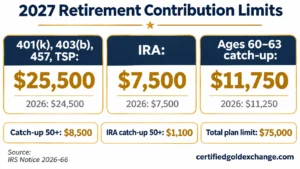
Quick Answer: For 2027, the IRS raised the 401(k), 403(b), most 457 and TSP deferral limit to $25,500, with catch-ups of $8,500 at 50+ and $11,750 at 60 to 63. The IRA limit stays $7,500, plus a $1,100 catch-up at 50+. Roth IRA income ranges also rose.
What You’ll Learn
- Every 2027 limit for workplace plans, IRAs, SIMPLE plans and Roth IRAs, side by side with 2026
- How much you can save at your age, including the larger catch-up for ages 60 to 63
- The Roth catch-up rule that applies if you earned more than $155,000 from your employer last year
- Why moving money into a gold IRA by transfer or rollover has no dollar limit, and why that matters more than the annual contribution limit
- The deadlines and timing moves that let you use the full 2027 limits
The 2027 Retirement Contribution Limits at a Glance
The IRS released the 2027 limits on November 12, 2026, in Notice 2026-66. These figures apply to the 2027 tax year.
| Limit | 2026 | 2027 |
| 401(k), 403(b), most 457 plans and TSP employee deferral | $24,500 | $25,500 |
| Catch-up, age 50 and older | $8,000 | $8,500 |
| Catch-up, ages 60 to 63 | $11,250 | $11,750 |
| Total contributions to a workplace plan account (employee plus employer) | $72,000 | $75,000 |
| IRA contribution | $7,500 | $7,500 |
| IRA catch-up, age 50 and older | $1,100 | $1,100 |
| SIMPLE IRA and SIMPLE 401(k) deferral | $17,000 | $17,500 |
| SIMPLE deferral, certain eligible employers | $18,100 | $19,100 |
| SIMPLE catch-up, age 50 and older | $4,000 | $4,000 |
| SIMPLE catch-up, ages 60 to 63 | $5,250 | $5,250 |
| Roth catch-up wage threshold | $150,000 | $155,000 |
| Compensation limit for plan contributions | $360,000 | $375,000 |
| Highly compensated employee threshold | $160,000 | $170,000 |
How Much Can You Put in Your 401(k) in 2027?
The employee deferral limit rises to $25,500 for 2027, up $1,000 from 2026. The same limit applies to 403(b) plans, most 457 plans and the federal Thrift Savings Plan.
Your age decides how much more you can add:
| Your age in 2027 | Deferral limit | Catch-up | Your maximum |
| Under 50 | $25,500 | None | $25,500 |
| 50 to 59, or 64 and older | $25,500 | $8,500 | $34,000 |
| 60 to 63 | $25,500 | $11,750 | $37,250 |
The ages 60 to 63 catch-up replaces the regular catch-up rather than adding to it. It was created by SECURE 2.0, and people who reach those ages often miss it because it disappears the year they turn 64.
Employer contributions sit on top of your deferrals. Total contributions to your account from you and your employer combined can reach $75,000 in 2027, not counting catch-ups.
Do Your 2027 Catch-Up Contributions Have to Be Roth?
They do if your wages from that employer in the prior year were more than $155,000. In that case, any catch-up contributions must go in as Roth (after-tax) contributions instead of pretax.
This doesn’t change how much you can contribute. It changes when you pay the tax: now instead of at withdrawal. If your plan doesn’t offer a Roth option, ask your plan administrator how it is handling catch-ups for higher earners.
How Much Can You Put in an IRA in 2027?
The IRA contribution limit stays at $7,500 for 2027, and the catch-up for people 50 and older stays at $1,100. That allows up to $8,600 a year at age 50 and older.
That limit is shared across all of your traditional and Roth IRAs combined, including a gold IRA. If you have a brokerage IRA and a gold IRA, the total of your contributions to both can’t go over $7,500, or $8,600 if you’re 50 or older. Excess contributions face a 6% excise tax for every year they stay in the account (IRS Publication 590-A).
Three rules people often miss:
- There’s no age cap. You can contribute to a traditional or Roth IRA at any age, as long as you or your spouse has earned income.
- A non-working spouse can contribute. A spousal IRA lets a married couple filing jointly fund an IRA for a spouse with little or no income, based on the working spouse’s earnings.
- You have extra time. 2027 IRA contributions can be made up to the tax filing deadline in April 2028, not counting extensions. Workplace plan deferrals, by contrast, have to come out of 2027 paychecks.
2027 Roth IRA Income Limits
You can contribute the full amount to a Roth IRA if your modified adjusted gross income is below the start of your phase-out range. Inside the range, your allowed contribution shrinks, and above it, you can’t contribute directly.
| Filing status | 2026 phase-out | 2027 phase-out |
| Single or head of household | $153,000 to $168,000 | $158,000 to $173,000 |
| Married filing jointly | $242,000 to $252,000 | $250,000 to $260,000 |
| Married filing separately | $0 to $10,000 | $0 to $10,000 |
Above these ranges, some people make a nondeductible traditional IRA contribution and convert it to a Roth. If you hold other pretax IRA money, part of that conversion can be taxable under the pro-rata rule, so plan it with your tax advisor first.
2027 Traditional IRA Deduction Limits
Anyone with earned income can contribute to a traditional IRA. Whether you can deduct the contribution depends on your income and whether you or your spouse is covered by a workplace retirement plan.
| Who is covered by a workplace plan | 2026 phase-out | 2027 phase-out |
| You, filing single or head of household | $81,000 to $91,000 | $83,000 to $93,000 |
| You, married filing jointly | $129,000 to $149,000 | $133,000 to $153,000 |
| Your spouse only, married filing jointly | $242,000 to $252,000 | $250,000 to $260,000 |
| You, married filing separately | $0 to $10,000 | $0 to $10,000 |
If neither you nor your spouse is covered by a workplace plan, your traditional IRA contribution is fully deductible at any income.
The Saver’s Credit Becomes the Saver’s Match in 2027
Starting with the 2027 tax year, the Saver’s Credit for contributions to retirement plans and IRAs is replaced by the Saver’s Match, a SECURE 2.0 change confirmed in the notice. Instead of reducing your tax bill, the federal match is deposited into an eligible retirement account.
The Saver’s Credit remains available for contributions to ABLE accounts. If you have claimed the credit in the past, ask your tax preparer how the match will work for your 2027 return.
What the 2027 Limits Mean If You Own or Want a Gold IRA
Most coverage of the new limits stops at the numbers. For someone thinking about physical gold in a retirement account, the more important point is what the limits don’t control.
Transfers and Rollovers Into a Gold IRA Have No Dollar Limit
The $7,500 limit applies to new contributions only. Moving existing retirement money into a gold IRA through a direct IRA-to-IRA transfer, or through a direct rollover from a 401(k), 403(b), 457 plan or TSP, has no dollar cap and doesn’t count against your annual contribution limit (IRS rollover rules).
That is how most of our clients fund their accounts. A transfer moves an established balance in one step, while annual contributions build slowly.
There is one rule to watch. If you take money out of an IRA yourself and redeposit it within 60 days, you can do that only once in any 12-month period across all your IRAs (IRS one-rollover-per-year rule). Direct custodian-to-custodian transfers don’t count toward that limit, which is why we use them as our standard process.
Why Annual Contributions Alone Rarely Fund a Gold IRA
A gold IRA has annual custodian and storage fees that don’t depend on the account size. On an account built only from one year’s IRA contribution, those fees take a large bite out of the balance.
That’s why we’re candid with people who ask about opening a gold IRA with a single year’s contribution. Often the better first step is to keep contributing where you are, then move a larger balance by transfer once the fees make sense. Our gold IRA fees and costs guide explains the math.
Higher 401(k) Limits Mean Larger Balances to Roll Over Later
Every dollar you add to a 401(k) under the higher 2027 limits is a dollar you can later move by direct rollover when you leave your employer or retire. Some plans also allow in-service rollovers after age 59½ while you’re still working.
Your plan document decides what’s allowed, so check with your plan administrator before assuming you can move money while employed. For the full process, see our Gold IRA guide.
Contributing to a Gold IRA You Already Own
If you already have a gold IRA, you can contribute cash up to the 2027 limit, as long as you have earned income and the combined total across all your IRAs stays within $7,500 or $8,600. The cash lands with your custodian, and you decide when to use it to buy metal.
Contributions to a Roth gold IRA follow the Roth income limits above. Contributions to a traditional gold IRA follow the deduction rules above, and the deduction doesn’t change based on what the IRA holds.
2027 Contribution Timing: What to Do Before January
- Raise your 401(k) deferral in December. Payroll changes can take one or two pay periods to take effect, so updating in December lets your first January paycheck reflect the higher 2027 limit.
- Mark your 60th birthday year. If you turn 60 in 2027, your catch-up rises to $11,750. Confirm your plan applies it automatically.
- Check last year’s wages if you’re near $155,000. That figure decides whether your 2027 catch-ups must go in as Roth.
- Spread IRA contributions across accounts carefully. If you fund more than one IRA, track the total so you don’t go over the combined limit.
- Remember the April deadline. 2027 IRA contributions can wait until the April 2028 filing deadline. 401(k) deferrals can’t.
Frequently Asked Questions About the 2027 Contribution Limits
What is the 401(k) contribution limit for 2027?
The 2027 employee deferral limit is $25,500. Savers 50 and older can add $8,500, and those 60 to 63 can add $11,750 instead.
What is the IRA contribution limit for 2027?
The 2027 IRA limit is $7,500, unchanged from 2026. Savers 50 and older can add a $1,100 catch-up, for a total of $8,600.
Can I contribute $7,500 to a gold IRA in 2027?
Yes, if you have earned income and haven’t contributed to any other IRA that year. The $7,500 limit is shared across all of your traditional and Roth IRAs.
Is there a limit on how much I can roll over from my 401(k) into a gold IRA?
No. Direct rollovers and transfers have no dollar limit and don’t count against your annual contribution limit.
What is the 2027 catch-up limit for ages 60 to 63?
The 2027 catch-up for ages 60 to 63 is $11,750. It replaces the regular $8,500 catch-up, bringing the total deferral limit to $37,250.
Can I contribute to a Roth IRA in 2027 if I make $160,000?
If you file single, yes, but only a reduced amount, because the 2027 phase-out runs from $158,000 to $173,000. If you’re married filing jointly, you can make a full contribution, because your range starts at $250,000.
Do my catch-up contributions have to be Roth in 2027?
Yes, if your wages from that employer in the prior year were more than $155,000. Below that, you can choose pretax or Roth if your plan offers both.
When is the deadline for 2027 IRA contributions?
The deadline is the tax filing deadline in April 2028, not counting extensions. 401(k) deferrals must come out of paychecks by December 31, 2027.
Is there an age limit for contributing to an IRA?
No. You can contribute to a traditional or Roth IRA at any age, as long as you or your spouse has earned income.
The Bottom Line on the 2027 Contribution Limits
For 2027, workplace plan savers get a higher deferral limit and larger catch-ups, especially between ages 60 and 63. IRA savers get the same $7,500 limit as 2026, with higher Roth IRA and deduction income ranges.
If you’re considering physical gold for retirement, the contribution limit matters less than you might think. The most common way to fund a gold IRA is a direct transfer or rollover of money you’ve already saved, and those have no annual dollar cap.
Disclaimer: This content is for general education and is not personalized tax, legal, or investment advice. Certified Gold Exchange is a precious metals dealer, not a financial or tax advisor. Confirm how these rules apply to your situation with a qualified tax advisor.
Have a question about the 2027 contribution limits? Reach our team at (800) 300-0715.