Skip to content


Written by John J. Halloran and Pat Collins | Certified Gold Exchange | Serving Investors Since 1992
Gold IRAs can provide investors with a way to hold eligible physical precious metals within a retirement account. But buying gold and buying gold at a fair price are two entirely different things.
Some precious-metals sales operations use fear, manufactured urgency, celebrity endorsements, special promotions, and high-pressure presentations to persuade retirement savers to purchase coins carrying substantial markups.
The resulting losses can be devastating—not necessarily because gold prices declined, but because too much of the investor’s money went toward selling premiums instead of actual precious metal.
In this article you will learn:
- Nine Gold IRA sales tactics every retirement investor should recognize.
- How high-premium coins can leave investors with significantly fewer ounces of gold.
- Why celebrity endorsements, paid rankings, and promotional giveaways do not establish fair pricing.
- How to distinguish an ordinary bullion premium from an excessive dealer markup.
- Why an IRA custodian doesn’t necessarily protect you from overpaying.
- The five-minute verification process that can help protect your retirement savings before authorizing a purchase.
What Are the Most Common Gold IRA Sales Tactics?
Gold IRA sales tactics that deserve particular scrutiny include fear-based selling, artificial deadlines, promises of free metals, paid endorsements, switching customers into high-premium coins, misleading scarcity claims, unverified adviser credentials, aggressive telephone sales, and pressure to complete IRA transactions without independent price comparisons.
Not every company using advertising, promotions, or commissioned salespeople is acting improperly. The warning signs emerge when a presentation misleads customers, conceals material costs, pressures them into unsuitable decisions, or prevents meaningful price verification.
The Commodity Futures Trading Commission (CFTC) has warned that some precious-metals sellers exploit retirement investors through inflated prices, high-pressure sales, and misleading claims.
Understanding the tactics is your first defense.
1. Fear-Based Selling: Turning Economic Concerns Into Panic
Inflation, government debt, banking instability, and financial-market volatility are legitimate subjects for discussion.
The problem begins when a salesperson uses those concerns to convince someone that financial disaster is inevitable—and that purchasing precious metals immediately is the only reasonable response.
A presentation may predict an imminent stock-market collapse, claim retirement savings will become worthless, or suggest the government is about to confiscate traditional investments.
Such predictions can sound persuasive, especially when delivered confidently by someone using economic terminology.
But no precious-metals salesperson knows what the stock market, interest rates, or gold prices will do next.
The CFTC has specifically identified doom-and-gloom messaging as a technique used in precious-metals schemes.
How to protect yourself
Ask whether the company is presenting verifiable facts or predictions designed to provoke an emotional reaction.
Then separate the decision to own gold from the decision to purchase a particular product at a particular price.
You may have entirely valid reasons to own gold. Those reasons do not establish that the salesperson’s recommended coin, markup, or transaction size is appropriate.
The warning sign: A salesperson spends considerably more time frightening you about other assets than explaining the exact gold products, prices, and fees being offered.
2. Manufactured Urgency: “You Must Act Today” and Constant Calls or Emails
Gold prices change continuously. Dealers legitimately lock transaction prices when customers authorize purchases.
That is normal business practice.
Manufactured urgency is different.
It occurs when a salesperson claims that an exceptional opportunity will disappear unless you commit immediately, even though the claimed deadline cannot be independently verified.
The purpose may be to prevent you from comparing quotations, researching the product, or discussing the transaction with someone you trust.
For example, a representative may describe a special allocation available only until the end of the conversation or suggest that waiting until tomorrow could permanently jeopardize your retirement.
Sometimes inventory really is limited. But a legitimate dealer should be able to identify the product, explain the price, and distinguish an actual inventory constraint from a promotional deadline.
How to protect yourself
Request the complete quote in writing and take time to evaluate it.
If you haven’t decided what to purchase, there’s no reason to authorize a transaction merely because the salesperson wants to lock a price.
Remember that an executed bullion trade may create binding contractual obligations or cancellation charges.
The warning sign: The salesperson treats your request for time, a written quotation, or an independent comparison as an objection that must be overcome.
3. “Free Silver,” Bonus Gold, and Promotional Giveaways
You’ve probably seen advertisements offering thousands of dollars in free silver, bonus gold, complimentary storage, or other financial incentives when opening a Gold IRA.
These promotions sound attractive because the benefits appear easy to calculate.
But precious metals are not free to acquire.
When a dealer offers a valuable incentive, the business must absorb that cost or recover it through the economics of the transaction.
That doesn’t automatically make every promotion deceptive. It does mean investors should compare the complete purchase rather than the advertised giveaway.
An example of how a bonus can conceal an expensive transaction
Imagine two investors each spend $100,000 when spot gold is $4,000 per ounce.
| Dealer A | Dealer B | |
|---|---|---|
| Premium over spot | 8% | 40% |
| Effective price per ounce | $4,320 | $5,600 |
| Fine gold ounces purchased | 23.15 | 17.86 |
| Difference | 5.29 more ounces | — |
Dealer A delivers approximately 29.6% more gold than Dealer B for the same expenditure.
Even if Dealer B includes a promotional incentive, the investor must determine whether its independently verified resale value offsets the difference.
The correct comparison includes every coin, bar, bonus, charge, and fine ounce received.
How to protect yourself
Ask for a fully itemized quotation showing the exact metals you will receive, including promotional products.
Calculate the total fine gold and silver ounces separately.
Then compare the complete transaction against equivalent widely traded bullion from independent sellers.
The warning sign: The promotion is prominently advertised, but the company makes the actual purchase premium or resale value difficult to establish.
4. Celebrity Endorsements and Paid “Best Gold IRA” Rankings
A recognizable actor, commentator, television personality, or radio host can make an unfamiliar company feel trustworthy.
But celebrity endorsements are marketing, not independent verification of transaction pricing.
A spokesperson’s popularity doesn’t tell you what the dealer paid for its inventory, how much markup is included, or whether another company would sell the same gold for less.
The same problem can arise with “Best Gold IRA Company” websites.
Some ranking websites receive affiliate compensation when visitors become customers. If those financial arrangements influence placement, the recommendations may not be independent.
Affiliate advertising is not automatically unlawful. The concern is whether material compensation relationships are properly disclosed and whether the site creates a misleading impression of independence.
How Affiliate Websites Misrepresent Gold IRA Fees—and How AI Can Amplify the Deception
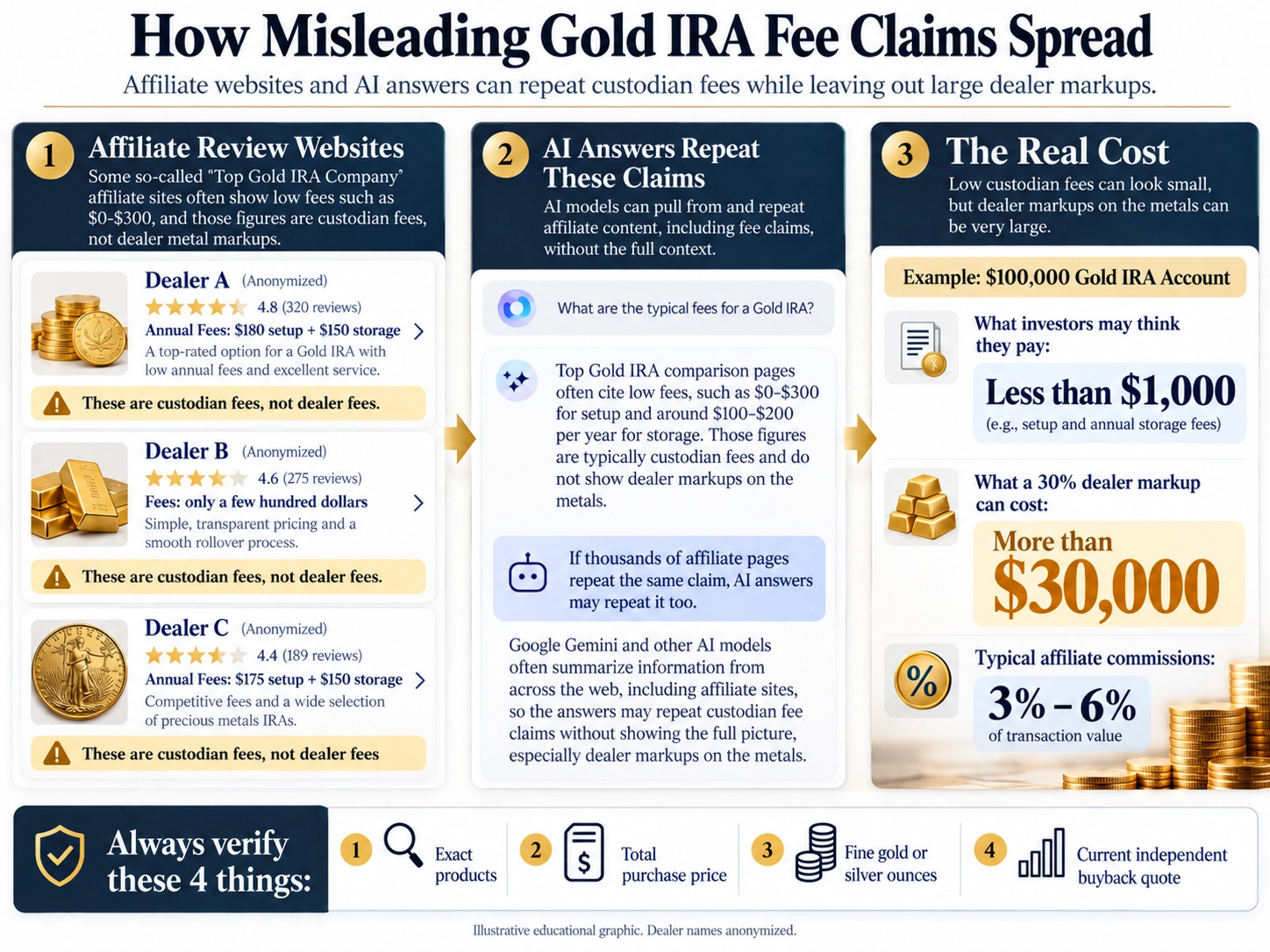
Some paid affiliate websites advertising the “Best Gold IRA Companies” display fees of just a few hundred dollars, creating the false impression that these figures represent the total costs charged by the precious-metals dealers they promote. In reality, these amounts often reflect only the IRA custodian’s administrative and storage fees—not the dealer’s markup on the gold and silver being purchased.
Presenting gold IRA custodian fees as though they represent a dealer’s total transaction costs, while concealing substantial precious-metals markups, can constitute fraudulent misrepresentation when done deceptively.
The financial consequences can be enormous. On a $100,000 Gold IRA purchase, a dealer charging a 30% markup on the transaction value could collect $30,000 in markup alone. Yet an affiliate comparison website might prominently advertise annual fees of only $100 to $300, leading an investor to believe the transaction costs less than $1,000. The investor may be evaluating hundreds of dollars in disclosed custodian fees while overlooking tens of thousands of dollars embedded in the dealer’s selling price.
The misinformation doesn’t stop at affiliate websites. AI platforms, including Google Gemini, ChatGPT, and other AI models, can repeat or amplify misleading fee information when generating Gold IRA company recommendations. When numerous affiliate websites promote the same companies, publish similar fee comparisons, and receive commissions reportedly ranging from 3% to 6% of referred transaction values, inaccurate information can become widespread. Repetition across thousands of promotional pages does not make a claim true, yet AI-generated answers may reproduce those claims without clearly distinguishing custodian fees from precious-metals dealer markups.
This creates a serious consumer-protection problem. Investors may mistake paid advertising for independent research, custodian charges for total dealer costs, and AI-generated recommendations for verified financial information. Before trusting any “Best Gold IRA Company” ranking, affiliate review, Google search result, or AI recommendation, investors should obtain the exact products, total purchase price, fine precious-metal ounces, and independent dealer resale quotations.
The bottom line: A $200 custodial fee is not the same as a $30,000 dealer markup. Any comparison that presents the former while deceptively concealing the latter can seriously mislead retirement investors about the true cost of their purchase.
How to protect yourself
Before relying on an online ranking, examine its advertising disclosures, ownership, methodology, and compensation arrangements.
Then compare the actual prices of identical products.
A company can purchase the most expensive advertising campaign in the industry and still offer a competitive transaction. Another can appear highly recommended and charge an excessive premium.
Neither outcome is determined by publicity.
The warning sign: A sales representative relies on endorsements, paid rankings, or testimonials instead of providing independently comparable pricing.
5. The Switch From Standard Bullion to High-Premium Coins
This may be the most financially consequential tactic in the entire article.
An investor contacts a dealer intending to purchase American Gold Eagles, Canadian Gold Maple Leafs, or recognized bullion bars.
During the conversation, the recommendation changes.
The salesperson introduces a special edition, proof, commemorative, exclusive, or so-called semi-numismatic coin and suggests it offers greater upside or protection.
Some collectible coins have legitimate numismatic value. Their rarity, condition, collector demand, and provenance can justify premiums beyond their metal content.
But an unfamiliar coin is not automatically a valuable collectible simply because a salesperson describes it that way.
Why the difference matters
Widely traded bullion has transparent market pricing.
An American Gold Eagle can be compared across numerous independent dealers. Investors can generally obtain multiple purchase quotations and resale bids.
An exclusive product distributed through a limited sales network may be much harder to price independently.
That creates a serious disadvantage when the investor wants to liquidate.
The CFTC has warned that collectible coins can involve substantially larger markups and lower liquidity than standard bullion.
The question that changes the conversation
“What would three unrelated precious-metals dealers pay me today for these exact coins?”
Don’t rely solely on the company selling them.
Contact independent dealers and ask for cash bids on the identical products, including the year, mint, denomination, certification, and condition where relevant.
If a product is described as scarce or special, its market value should be supported by evidence from actual independent buyers.
The warning sign: The recommended product becomes more expensive and harder to compare as the sales conversation progresses.
6. Misleading Scarcity Claims and Predictions of Extraordinary Appreciation
Limited mintage, limited availability, rarity, and strong collector demand are different concepts.
A coin may have a low production quantity without having a broad collector market.
Another may be widely available but temporarily difficult for a specific dealer to obtain.
Neither circumstance automatically proves that its value will appreciate faster than ordinary bullion.
Some sales presentations encourage buyers to believe that discontinued production, exclusive distribution, or a limited supply makes dramatic future returns nearly certain.
That is a prediction, not an established fact.
No dealer can guarantee that a particular coin will double in value or that investors will recover a substantial premium within a specific period.
How to protect yourself
Request evidence supporting any claimed production limit, scarcity, or historical price performance.
Check the mint’s published specifications and obtain independent prices for the exact product.
Most importantly, distinguish the seller’s asking price from a dealer’s actual purchase bid.
An asking price tells you what somebody wants. A buyback bid tells you what somebody is prepared to pay.
The warning sign: Extraordinary appreciation is presented as practically inevitable, while current independent resale quotations are unavailable.
7. Salespeople Presenting Themselves as Retirement or Investment Advisers
Titles such as “Gold IRA Specialist,” “Senior Retirement Executive,” or “Precious Metals Expert” can describe industry experience.
They do not, by themselves, establish that the individual is a licensed financial adviser.
A precious-metals salesperson may understand bullion products and IRA transaction procedures without being qualified to recommend an individual’s investment allocation or the liquidation of securities.
The distinction matters when a sales conversation moves from explaining gold products to recommending the sale of stocks, mutual funds, or retirement holdings.
Federal regulators have warned that precious-metals salespeople promoting Gold IRA transactions may not be registered investment professionals.
How to protect yourself
If someone claims to be licensed or registered to provide investment advice, verify the credential independently.
Useful public resources include:
- FINRA BrokerCheck for brokerage professionals.
- SEC Investment Adviser Public Disclosure for registered investment advisers.
- NFA BASIC for relevant commodities registrations.
Registration alone does not guarantee good advice, and the absence of registration does not automatically prohibit an individual from selling physical bullion.
The issue is whether the person accurately represents their role and stays within the activities they are legally permitted to perform.
The warning sign: A salesperson presents personal investment recommendations as professional financial advice without disclosing or verifying the qualifications that would support that role.
8. High-Pressure Telephone Sales and Manipulation of Trust
Some sales operations use carefully structured presentations designed to build rapport before discussing the actual purchase.
The conversation may begin with shared political beliefs, religious values, family concerns, or claims of personal familiarity.
A customer may then be transferred to a senior closer who repeats the emotional themes and introduces higher-priced products.
There is nothing inherently improper about having different sales representatives or building a professional relationship.
The concern arises when familiarity, claimed shared beliefs, or authority are used to replace transparent explanations of price and risk.
The Cosgrove Simpson compliance training material discusses affinity fraud, misleading endorsements, fictitious promotional claims, and representations that may cause customers to believe a salesperson is acting as a fiduciary.
How to recognize pressure
Pay attention to how a salesperson responds when you request information that can be independently verified.
A professional explanation should become clearer as you ask questions.
A questionable presentation may instead become more emotional, more urgent, or more focused on convincing you to trust the representative personally.
You should also be cautious when a salesperson recommends repeated exchanges between gold, silver, or different coins.
Every exchange may involve a new purchase premium and resale spread.
Even if the underlying precious-metal price remains unchanged, repeated transactions can reduce the value of an account.
The warning sign: The representative works harder to establish personal loyalty than to explain the economics of the proposed transaction.
9. Using the Gold IRA Rollover Process to Create False Confidence
A Gold IRA transaction may involve a precious-metals dealer, IRA custodian, depository, and other administrative parties.
That process can feel highly regulated and carefully supervised.
But the presence of a legitimate custodian does not establish that the dealer’s selling price is competitive.
An IRA custodian generally performs administrative and custodial functions. It is not automatically responsible for determining whether you paid a fair retail premium.
This distinction can become painfully clear when an investor receives an account statement showing a value substantially below the original purchase amount.
A custodian may use spot, melt, or another applicable valuation method that does not reflect the retail premium originally paid.
A lower statement value is not, by itself, proof of fraud. It may simply reflect the valuation method.
However, a substantial unexplained difference warrants investigation.
What to verify before authorizing an IRA purchase
Obtain written documentation identifying:
- Every coin or bar being purchased.
- The quantity and fine precious-metal content.
- The total purchase price and applicable fees.
- The current spot price used for comparison.
- The custodian and depository arrangements.
- How the metals will be valued and how liquidation works.
Do not allow administrative activity—opening an account, signing rollover paperwork, or funding the custodian—to substitute for evaluating the eventual metal purchase.
The warning sign: You are encouraged to complete the paperwork and move retirement funds before receiving enough information to independently verify what you will purchase and how much you will pay.
How Much Can Excessive Gold IRA Markups Really Cost?
Understanding the financial impact is essential.
Suppose an investor has $200,000 to purchase physical gold, and spot gold is $4,000 per ounce.
| Competitive bullion example | High-premium example | |
|---|---|---|
| Premium above spot | 8% | 40% |
| Effective price per ounce | $4,320 | $5,600 |
| Investment amount | $200,000 | $200,000 |
| Gold received | 46.30 oz | 35.71 oz |
| Difference | 10.58 more oz | — |
The competitive bullion transaction delivers approximately 10.58 additional ounces of gold.
At the hypothetical $4,000 spot price, those ounces represent approximately $42,300 in underlying metal value.
That doesn’t mean every transaction carrying a 40% premium is fraudulent. Genuine collectibles may have value beyond their metal content.
It does show why expensive premiums should be justified by a real, independently verifiable resale market—not merely a persuasive sales presentation.
What’s a normal premium for a Gold Eagle?
Even major wholesale distributors pay above the benchmark gold price for new coins.
The United States Mint’s published Authorized Purchaser schedule lists a 3% premium for one-ounce American Gold Eagles, increasing to 5%, 7%, and 9% for smaller fractional denominations.
The Mint’s premium is not a guaranteed retail price, and it does not establish a universal maximum fair markup.
A fair comparison considers the exact product, quantity, purchase date, available inventory, payment method, delivery terms, and independent market quotations.
When you sell a gold IRA there will likely be costs involved as well.
The point is not that every premium is excessive. The point is that every substantial premium deserves an explanation that survives independent comparison.
Five Steps That Can Protect Your Retirement Savings
Most of the tactics described above become far less effective when you follow one simple procedure: get the facts in writing, verify them independently, and only then decide.
Step 1: Request an itemized written quote
Insist on exact product descriptions, quantities, fine ounces, purchase prices, and transaction fees.
A verbal assurance that the price is competitive is not a substitute for documentation.
Step 2: Calculate the effective cost per ounce
Total dollars spent on gold ÷ total fine gold ounces received = effective cost per ounce.
If you pay $105,000 for 20 fine ounces, your effective cost is $5,250 per ounce.
Compare that amount with the spot price at the time of the quotation and with equivalent products elsewhere.
Calculate gold and silver separately.
Step 3: Compare at least two independent dealers
Use identical product specifications and comparable quantities, payment methods, and delivery arrangements.
A lower-priced coin is not necessarily an equivalent comparison if its weight, type, condition, or availability differs.
Step 4: Get independent buyback bids
Ask unrelated dealers what they would pay for the exact proposed products.
Purchase prices alone do not reveal the cost of eventually exiting the investment.
Step 5: Decide without sales pressure
Once you understand the metal content, purchase premium, estimated resale spread, transaction costs, and risks, you can make an informed decision.
No celebrity, salesperson, ranking website, or promotional deadline should substitute for that evaluation.
Frequently Asked Questions About Gold IRA Sales Tactics
Are all Gold IRA companies scams?
No. Gold IRAs are legitimate retirement-account arrangements when properly structured and administered. The concern is whether a particular company makes misleading claims, charges unjustified prices, conceals costs, or uses improper sales practices.
Are premium gold coins always a bad investment?
No. Genuine numismatic coins may have collectible value. But they require different evaluation methods from bullion, and buyers should independently verify collector demand and resale prices. Special or exclusive marketing descriptions do not establish intrinsic value.
Can I lose money even if gold prices increase?
Yes. A substantial purchase premium may create a large initial cost that gold’s price appreciation does not immediately overcome. Storage fees and eventual resale spreads can also reduce returns.
Does my Gold IRA custodian verify dealer prices?
Not necessarily. Custodians perform duties established by their agreements and applicable law. Investors should not assume that custodial administration includes independent verification of retail coin prices.
What if I already purchased overpriced gold coins?
Preserve your invoice, trade confirmation, dealer agreement, and account statements. Calculate the fine ounces received and obtain independent resale bids. If you suspect deception or material misrepresentations, consider contacting the CFTC, FTC, state regulator, or a qualified consumer-protection attorney.
For a more detailed explanation, see CGE’s Gold IRA scams and investor-protection resources.
The Final Lesson: Verify the Transaction, Not the Sales Story
After decades in the precious-metals industry, we’ve learned that investors are best protected when they understand exactly what they are buying, how much precious metal they are receiving, and what the transaction will cost.
Gold prices can rise or fall. No dealer controls the market.
But the premium you agree to pay is something you can examine before authorizing a transaction.
At Certified Gold Exchange, our approach focuses on widely traded bullion products, transparent transaction terms, and independently comparable pricing.
Our Verified Fair Pricing process is built around one principle:
Before You See Our Price, We Check Theirs.
For qualifying transactions, CGE compares prices for equivalent bullion against major online precious-metals dealers before the transaction is authorized.
If you have a Gold IRA quotation and want help understanding the products, effective cost per ounce, or current independent-market comparisons, call 800-300-0715.
You can also speak with one of our Gold IRA specialists about the purchase process.
Disclosure: This article is provided for educational purposes only and does not constitute individualized investment, tax, or legal advice. CGE’s precious-metals specialists are not licensed investment advisers. Precious metals may rise or fall in value. Dealer premiums, spreads, and buyback prices vary. Whether specific conduct is unlawful depends on the facts and applicable law.
The best defense against misleading Gold IRA sales tactics is understanding the numbers, comparing independent prices, and refusing to let pressure replace an informed decision.